Trial by jury
Trial by jury, the bedrock of Anglo-American criminal justice, is transformed in Agatha Christie's Murder on the Orient Express from a procedural safeguard into the structural and moral framework for a private execution. The novel does not merely reference the concept; it literalizes it. Twelve passengers aboard the snowbound Simplon Orient Express, each bearing a personal wound from the Armstrong kidnapping case, constitute themselves as a jury of the victim's peers, deliberate his guilt, and carry out the death sentence that the American legal system failed to deliver. This appropriation of the jury's form—its number, its deliberative function, its claim to represent communal justice—becomes the novel's central conceit, forcing a confrontation between legal formalism and the demands of moral vengeance.
The Jury as Structural Blueprint
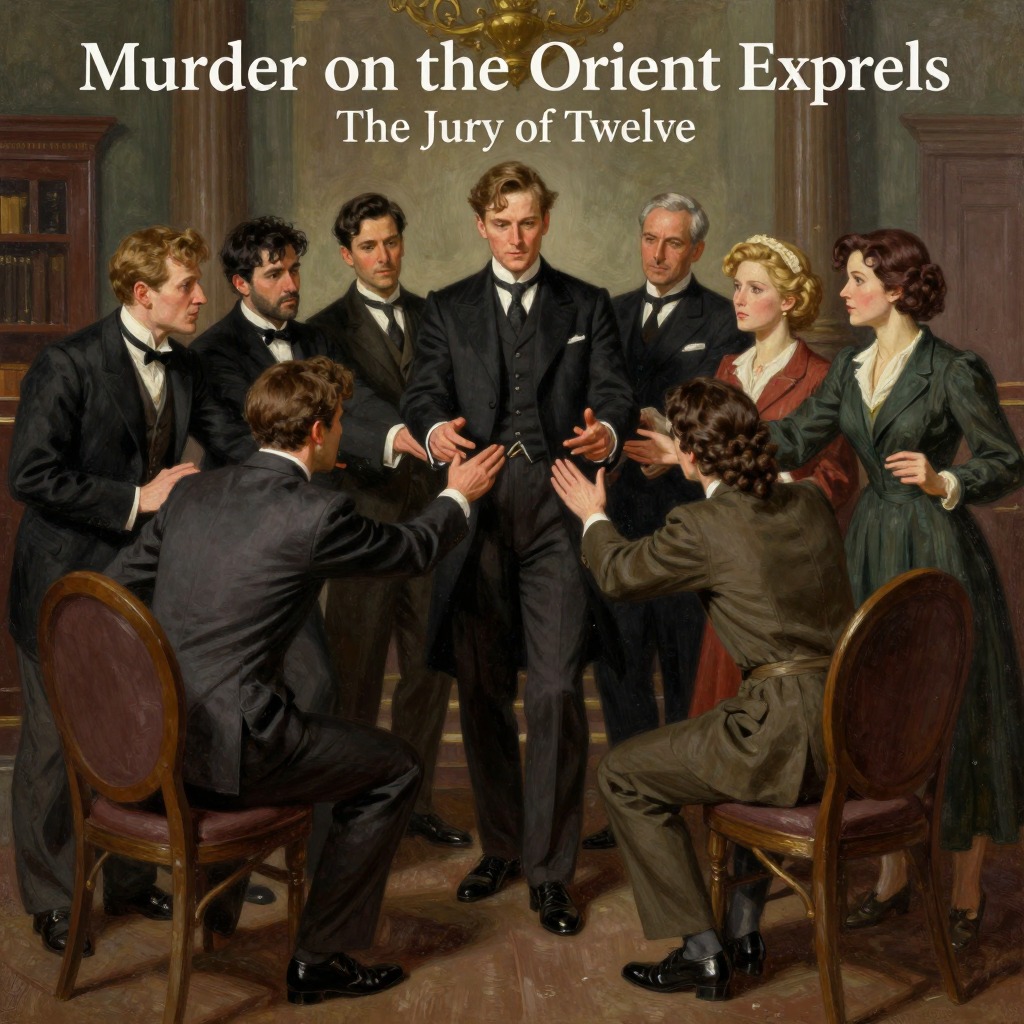
The most explicit signal of the jury's role as the crime's organizing principle comes from Hercule Poirot himself. Confronted with the impossibility of any single passenger having acted alone, he realizes that the twelve stab wounds correspond to the twelve members of a jury, and that the extraordinary diversity of the passengers—an Italian chauffeur, an English governess, a Swedish nurse, a German maid, a Russian princess, an American detective, and others—mirrors the cross-section of society that a jury is meant to represent. Poirot states directly that he visualized "a self-appointed jury of twelve people who had condemned him to death and who by the exigencies of the case had themselves been forced to be his executioners." The number twelve is not coincidental; it is the deliberate signature of a collective judgment. Colonel Arbuthnot, the stiff-upper-lip British officer, is described as "very keen on having twelve of us. He seemed to think it made it more in order." This insistence on the correct number reveals the conspirators' need for the ritual legitimacy that the jury's form confers, even when the substance of that form—impartial deliberation, unanimous verdict, state-sanctioned punishment—has been entirely inverted.
The Rejection of Formal Legal Process
Colonel Arbuthnot, in his first interview with Poirot, articulates the very principle that the conspiracy will violate. When Poirot suggests that Arbuthnot might prefer private vengeance to legal process, the Colonel replies with unmistakable conviction: "Well, you can't go about having blood feuds and stabbing each other like Corsicans or the Mafia. Say what you like, trial by jury is a sound system." This statement, made before the crime is even discovered, establishes Arbuthnot as a man who believes in the rule of law. His subsequent participation in the lynching is therefore not a rejection of the jury system's value but a desperate resort to its form when its substance has failed. The novel thus presents the conspiracy not as a repudiation of trial by jury but as a tragic supplement to it—a jury that operates when the official jury has been corrupted or circumvented. The conspirators, as Linda Arden explains, "decided then and there (perhaps we were mad—I don't know) that the sentence of death that Cassetti had escaped had got to be carried out." The word "sentence" is carefully chosen: they are not murderers but executioners, carrying out a judgment that the state had pronounced but failed to enforce.
The Collective Execution as Verdict
The execution itself is staged as a ritual of collective responsibility. Each of the twelve conspirators enters Ratchett's compartment in turn and stabs him, so that no single person can know which blow was fatal. This distribution of the act of killing mirrors the distribution of judgment in a jury: the verdict is the product of the whole, not of any one member. Poirot notes that "each person in turn entered Ratchett's darkened compartment through that of Mrs. Hubbard—and struck! They themselves would never know which blow actually killed him." The darkness of the compartment, the anonymity of the blows, the shared guilt—all of these elements transform the murder into a collective act that mimics the impersonal authority of a jury's verdict. The conspirators are not vigilantes acting on individual passion but a body acting on a collective decision. The novel's moral complexity lies precisely in this tension: the act is murder, but its form is that of a judgment.
The Official Solution and the Suppression of the Truth
The novel's conclusion dramatizes the conflict between legal form and moral substance. Poirot presents two solutions to M. Bouc and Dr. Constantine: the first, a false but legally tidy explanation involving an outside assassin who escaped before the train was snowbound; the second, the true but legally explosive account of the twelve-person jury-execution. M. Bouc, as a director of the Compagnie Internationale des Wagons Lits, immediately chooses the first solution, declaring it "the correct one—decidedly so." Dr. Constantine, the medical examiner, agrees, retroactively dismissing his own earlier findings as "fantastic suggestions." The official record of the crime will therefore be a lie—a lie that preserves the appearance of legal order while concealing the reality of collective vengeance. Poirot, having placed his solution before them, "retire[s] from the case." The novel thus ends with a deliberate act of legal fiction: the jury system is formally upheld by suppressing the truth that a jury has already acted in its place.
Thematic Significance: Justice, Form, and the Limits of Law
The trial-by-jury motif in Murder on the Orient Express is not merely a clever plot device but a sustained meditation on the relationship between legal procedure and moral justice. The novel asks whether a system that allows a guilty man to escape punishment through wealth and technicalities retains its moral authority. The conspirators' answer is a qualified no: they do not reject the jury system itself but act as its surrogate when it fails. Yet the novel does not endorse their action without reservation. The elaborate deception, the lies told to Poirot, the alteration of passports, and the final suppression of the truth all suggest that the conspirators themselves recognize that their act, however justified in their own eyes, cannot be accommodated within the legal framework they have violated. The jury of twelve has rendered its verdict, but that verdict can never be spoken aloud in a court of law. The novel's enduring power lies in its refusal to resolve this tension, leaving the reader to weigh the competing claims of legal form and moral necessity.